Wednesday, August 15, 2012

The Strasburg Decision

This is one of those blogs in which, even as I start typing, I'm not 100% sure where I'm going. I'm pretty sure, but I could talk myself in and out of the decision ten times before I decide where I sit.  This much-debated Stephen Strasburg decision is a tough one.

My first look at Strasburg, when he was at
San Diego State. We all knew he was a star then.
I remember seeing Strasburg when he came to Fort Worth for the Mountain West tournament as a much-hyped college pitcher throwing over 100 mph. He was worth the price of admission. You just knew he was going to be a franchise arm for someone.

The Nationals know they have a star, so they are exercising extreme caution with a guy who has already undergone Tommy John surgery. The plan was to shut him down this season after 160 innings. Then something crazy happened: they became World Series contenders a year ahead of schedule. 2012 was supposed to be a step forward, but not like this. Bryce Harper was ready sooner than expected, the pitching staff clicked and the Nationals are slowly pulling away in the NL East.

The Washington Nationals can win the World Series this year. THIS year! Yet, they are committed to shutting down their ace? It's quite a predicament, but the pros and cons are pretty obvious.

Why you shut him down
- It is what the doctors suggested. It's the safe option for an arm that could be worth over $200 million.
- You have him under contract for five more seasons. You want him pitching all five of those seasons. Maybe, if you protect his arm, that will work in your favor when it's time to renegotiate.
- It's less likely, but you could still win the World Series without him, and he comes back on schedule next year.
- In the playoffs, when times get tough, teams are tempted and sometimes forced to start their guys on three days' rest. You absolutely cannot do that with Strasburg, especially after he starts stretching that innings limit.

Why you keep him going
- YOU CAN WIN THE FREAKING WORLD SERIES. You need that ace who can win a playoff game when the other team is starting its ace.
- Tomorrow is never promised. Sure, it looks good for the Nationals for the next five years, but you never know. Players retire, get injured, or unexpectedly stop producing. If you can win now, win now.
- Strasburg says he's fine and wants to keep going
- Those 160 innings are an inexact science. It's not like once he gets to that 161st inning, his arm falls off. You could shut him down at 140, and he could still blow his arm out next year. You just can't predict that.

I'm not a Major League coach. I'm not a doctor. But I've never fully subscribed to the idea of pitch counts and innings as how long you stick with a pitcher. I think they are more like indicators for you to pay closer attention to a guy's command and velocity. It's more about how he feels and how effective he is. Some guys wear down at 90 pitches. Others are just at strong at pitch 120 as they are at pitch 10. I know Nolan Ryan is on board with this. He wants his Texas starters to pitch as long as they can. They've been to back-to-back World Series.

To be fair, though, Texas does have two starters out for the year with arm trouble. Was that because they were overused? You can't prove that one way or the other.

Strasburg will watch the postseason
from the bench. Is that the right call?
If Strasburg says he feels fine, and the doctors say his arm is structurally sound, I say you roll the dice and let him keep going. Like I said, future success is not promised to any franchise. The Nats have a shot at a championship right now. They should go all in.

Is it a risk? Sure. But I suppose pitching him even 1 inning is a risk to some extent.

Ultimately, it's not my arm and it's not my decision. I won't lose a dime based on this. The Nationals, Strasburg and Scott Boras (his agent) all have a lot of cash on the line. While I'm sure Boras is also looking long term for his client's health, the only opinions that matter are in the Nationals' front office. Strasburg will be shut down. I can't say it's a terrible decision, either, despite the fact I lean towards letting him pitch on.

Just get ready, though, if the Nationals are eliminated from the postseason because they don't pitch well enough. There will be a shot of Strasburg (and probably some of his teammates) just fuming in the dugout. And the criticism will begin.

Ten years down the road, though, if Strasburg is still in Washington and he's won multiple Cy Young Awards and led the Nationals to a World Series title or two, then the Nats will have the last laugh. Enjoy waiting that out.

Saturday, August 11, 2012

My Favorites from the 2012 Olympics

As the Olympics wrap up, it's time to look back on the athletes that truly made themselves famous from this year's games. We all have our favorites, but here are the athletes I'll remember most and believe we'll hear from a lot between now and Rio in 2016.

10. McKayla Maroney, gymnastics
Maroney's sense of humor has turned a negative into a positive.
The gold that she helped her team win was great, and her individual silver in the vault was nice, albeit disappointing for her. However, her scowl at the medal ceremony made her famous. "McKayla is not impressed" has become an internet sensation. Her great sense of humor about it, however, has made her a big winner.
After first seeing her upset expression, some may have labeled her a poor sport who would just pout over being mocked on the internet. Not even close to the truth. McKayla has embraced and owned her scowl, and I fully expect her to cash in on it. Look for several commercials with her not being impressed with products very soon.

9. Allyson Felix, track
After settling for silver in 2004 and 2008, Felix finally broke through for gold in the 200 meters. At age 26, it was probably her last chance to do so. Throw in a couple of golds in relays, and she is now a highly marketable face in track and field.

8. Destinee Hooker, volleyball
People chuckled at her name, but then they saw her play. She was dominant for Team USA, and she finished as the second-leading scorer in the Olympics. While the silver medal may have been a disappointment for her and her team, Hooker made her mark. The 24-year old is likely to be the face of USA volleyball for at least the next four years.


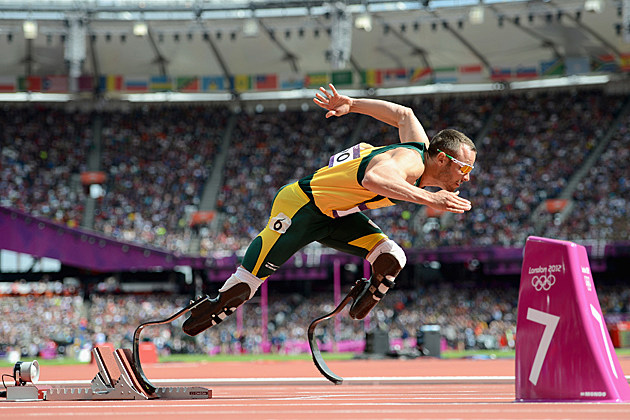
Pistorius was an amazing story by just showing up in London.
7. Oscar Pistorius, track
He didn't get a medal, but he didn't need to. A double amputee running in the Olympics? What an inspiration. The image of him running in the 400 will last forever. He'll be able to use his now worldwide fame to inspire countless others who have disabilities, and even those who don't.

6. Michael Phelps, swimming
Did he dominate like he did in 2008? No, but no one really expected him to. He did, however, have a more impressive showing than fellow American and rival Ryan Lochte (who wasn't bad. He just wasn't Phelps). By the time the Games were done, Phelps had two more individual gold medals, six medals overall, and he had cemented his legacy as the certainly the greatest swimmer of all time and arguably the greatest Olympian. Rowdy Gaines said it best when he said, "Gosh I'm gonna miss this man." We all are.

5. Gabby Douglas, gymnastics
Gymnasts have so much pressure because most of them only have one shot at a medal. In a sport in which 20 is "old," Douglas capitalized on her opportunity. She now will forever be mentioned with Mary Lou Retton, Carly Patterson, and Nastia Liukin as American all-around gold medalists. She's a winner no matter how she styles her hair.

4. Misty May-Treanor and Kerri Walsh Jennings, beach volleyball
Misty and Kerri cemented their place in Olympic history.
Can you even name another beach volleyball team off the top of your head? Since it became an Olympic sport in 2004, these two have owned it. They've captured gold all three times, and their humble attitudes and great relationships with the fans have made them immensely popular. Misty and Kerri cemented their legacy in this relatively new sport (at least to the Olympics). They will be the standard by which all future teams in the sport are measured.

3. Missy Franklin, swimming
There were a lot of female swimmers to choose from: Dana Vollmer, Rebecca Soni and Allison Schmitt all had great showings. Franklin, however, was a breakout star as a teenager. Relatively unknown a month ago to those who don't follow swimming (so, most of us), Franklin is now a household name. She swam in seven events and came home with four golds (including sweeping the 100 and 200 backstroke golds) and a bronze. She did it at age 17. While it remains unclear if she'll cash in on her fame by turning pro now or swim in college first, it's extremely likely we see her in at least two more Olympics.

The new face of USA soccer.
2. Alex Morgan, women's soccer
Two years ago, it would have seemed impossible that any athlete could have surpassed Hope Solo as the most popular soccer player in America. You could argue that Morgan has done it, and it's not because of her good looks, either. It's also not because Solo has lost any popularity. Morgan's popularity has just skyrocketed.
Anyone who watched the World Cup and these Games knows that she is the spark plug to the USA offense now. If she's not scoring goals herself, she's causing havoc and creating room for others to do so. Her header to defeat Canada (her third in six Olympic matches) was one of the signature moments of the Olympics.
Abby Wambach has been the leader and top goal scorer for a while, but Morgan is now ready to assume the role of leader and star player. By the time the next World Cup rolls around, I fully expect that she'll carry the title of best player in the world, and people may even start comparing her to the legendary Mia Hamm.

1. Usain Bolt, track
Cocky? Sure, but Usain Bolt backs it up. Every time.
While I'd love to put an American at the top of this list, there's no denying that Bolt stole the show. He dominated his sport unlike any other athlete. While Carl Lewis has questions about Jamaican drug testing, right now there is no proof. So, I just sat back and enjoyed Bolt's dominance. He is without question the fastest man in the world. He breaks world records while running half speed the last ten meters. I'm just curious what else he could do. He says he wants to play soccer. Not sure if he'd make Manchester United like he wants, but I'd watch.

There are several other great stories I left out: Nathan Adrian (gold in men's 100 free), Katie Ledecky (gold in 800 free at age 15), and hometown star Jessica Ennis (heptathalon gold) to name a few. It just shows how jam-packed the Olympics are with amazing stories.

I've really enjoyed these Olympics, and now these athletes can go out and capitalize on their new found (or reaffirmed) fame. They've earned it.

All photos courtesy Getty Images.

Sunday, July 29, 2012

The Great Dream Team Debate

I'm a little late to the party here (moving from Tulsa to DFW has put my blog on a bit of a hiatus), but the water cooler debate about whether or not this year's USA men's basketball team could beat the storied 1992 Dream Team both intrigues and amuses me.
No team will ever match the greatness of the 1992 Dream Team.

I liked Larry Bird's answer, when he said that they probably could considering he, Jordan, Magic and company are all 20 years older now. (Side note to make you feel old: Anthony Davis is on this year's team and wasn't even born when the Dream Team won gold.)

Bird's comment, though, falls in line with my opinion of the whole thing: we're talking about two different eras, so the argument is full of holes.

Could this year's team beat the 1992 team as they were that year? Actually, yes, they probably could. Bird retired just after the Olympics, and Magic had been away from the game for a year after being diagnosed with HIV. Plus, today's athletes are, generally speaking, in much better shape than athletes from 20 years ago. Training, teaching, and nutrition have all seen a lot of advances since then. So, could they beat that 1992 team one time? Sure, they could.

Are they greater than that team? Not even close.

The greatness of athletes is ultimately determined by how great they are in the eras in which they played. Athletes get bigger and faster and stronger over time, making today's teams in all sports capable of greater feats than athletes from decades ago. That's why track and swimming records fall year after year. Each generation strives to be greater than the previous one, and each generation finds a way to do so through advances in teaching and training.

While Babe Ruth would probably be great against any generation, I doubt he'd have 714 career home runs if we could get a time machine and put him in today's Major League Baseball. He was truly ahead of his time in the 1920's, though. The major league career record for homers at the time was 138, and he blew past that on his way to 714. That's why he is viewed as the greatest slugger of all time.

Athletes change over time. Judge them against their own eras.
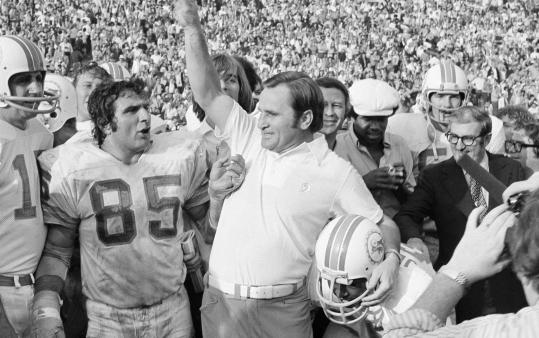
The 1972 Dolphins are still the only team to go through an NFL season undefeated. Look at the average size of their offensive and defensive lines, though. The '72 Dolphins, like all teams in those days, averaged about 250 pounds up front on offense and defense. Any team in the NFL today averages well over 300 on the offensive line and has lean, powerful guys approaching 300 pounds or more on defense. Simple logic says those teams would blow the '72 Dolphins off the ball and dominate the game. Does that mean today's teams are greater? Absolutely not. The '72 Dolphins were perfect in their own time, and that is why they are still the gold standard for NFL champions.

The 1992 Dream Team, even with Bird and Johnson past their prime, were far and away more dominant in their own time. They won by an average of 44 points per game, and 11 of the 12 members are in the Hall of Fame. Christian Laettner, a rookie out of Duke at the time, is the lone non-Hall of Famer, but he is in the College Basketball Hall of Fame.

Is this year's team that far ahead of the rest of the world? I don't think so. That's partially because the rest of the world has gained a lot of ground on the United States since 1992. The Dream Team embarrassing the rest of the world served as plenty of motivation for the development of international players. That said, will 11 of these 12 players make the Hall of Fame? It's hard to tell because many are so young, but my best guesses on that right now:

Yes: Kobe Bryant, LeBron James, Kevin Durant (I know it's early for him, but he's well on his way)
Maybe/Still work to do: Chris Paul, Carmelo Anthony, Deron Williams
No: Tyson Chandler, Andre Iguodala
Too soon to tell: Kevin Love, Russell Westbrook, James Harden, Anthony Davis

So, while these current guys are more athletic and better conditioned than the 1992 team, in my opinion, the absolute best they could achieve would be 10 out of 12 Hall of Famers.

Despite the generation gap, several of the Dream Team members (Jordan, Ewing, Robinson, Pippen, Malone, Barkley) were in their prime. While I think the current team could get a win, I still think the Dream Team would win a best-of-seven series. But we'll never know, so it will just remain a water cooler debate or something people simulate on video games.

To me, though, there is no question that the greatness of the Dream Team far exceeds the greatness of this team, and that's all that really matters.

Friday, July 13, 2012

Don't be an NBA Wingman

You're all familiar with the concept of a wingman, right? He's the guy who goes with you to the bar to help you hook up with a girl, especially in a situation when said girl has a less-than-desirable friend who needs to be entertained so you can get some alone time with the hottie.

Asking your friend to be a wingman is one thing. Friends will do that. Asking a stranger or a rival to do it, though, has to be awkward and pretty close to impossible. That's what I feel some NBA teams are doing these days: they are finding a third team to be their wingman to help them make a big move.

I can't fathom why a team would want to be the "third team" in a trade that would help a franchise land a superstar like Dwight Howard. I'm just trying to imagine that phone conversation:

A player like Dwight Howard can instantly
make a team a contender. So, why help them?
"Hey, man, it's Billy King with the Nets! Look, we've got a great shot to get a franchise-altering player in Dwight Howard. We just need you to throw us a bone and help us make it happen. You in?"

"Um, what's in it for me?"

"You just need to take a couple players off our hands, maybe give up a draft pick or two, and hey, I'll even throw a little MarShon Brooks action your way to make it worth your time."

"Oh, well, heck yeah, I'm in! Good luck with Howard, buddy!"

I just don't get it. With all due respect to MarShon Brooks, who may be a pretty nice NBA player, he isn't a guy who instantly makes you relevant. 

You want me to help facilitate a trade for a superstar that will change the landscape in the Eastern Conference? No way, man. I'd respond with, "Hell, no. Figure it out your own dang self."

Being forced to trade a player that you can't re-sign is one thing. I get that. If a player is going to leave as a free agent, sometimes you have to make a deal to make sure your franchise isn't left empty-handed. I just don't get being the outside party who gets little out of the deal and just helps another team get significantly better.

The only reason I might possibly accept would be if the wingman team is in the superstar's conference now and wants to facilitate a trade to get him out of the conference. That might make a little sense, especially if it helps the wingman team in some significant way. That doesn't change the fact, though, that the wingman team is helping another team get to a championship level.

The NBA is clearly going in a direction where the formula for success is to acquire three superstars and then fill in the rest with role players. Why a team would help another acquire one of the game's elite stars is beyond me. I'm glad the Clippers or Timberwolves or whichever other teams were reportedly involved didn't let it happen (at least not yet). 

In a league where there is a big gap between the Haves and Have Nots, the Have Nots shouldn't be helping the Haves have more.

So to all those, "third" and "fourth" teams out there in the trade market, when someone calls asking you to be their wing man, just say "Bull----. You can be mine."

Tuesday, May 22, 2012

The Last Shot

I think the idea of "who takes the last shot" is overblown. Who should take it? The guy who's open and has the best shot to make it. That's who.

Ideally, you want your superstar to take the big
shot, but you have to realize he can't always do it.
Recently in the playoffs, teams have been ripped for not letting a superstar like Kobe Bryant or LeBron James shoot the ball. Obviously, you'd love for your star to take the big shot. That opportunity isn't always there, however.  I don't think it's ridiculous to let another player shoot if he has a good look.

The Lakers were ripped when Steve Blake was wide open for a three at the end of Game 2 against the Thunder. Yes, he missed. But is a WIDE OPEN Steve Blake three really a worse shot than Kobe being double teamed? I don't think so.

By the way, what happened when Kobe got the ball with a chance to tie Game 4 in the closing seconds? He missed, too. Nothing is automatic, not even a superstar like Kobe.

LeBron James was ripped for passing to Mario Chalmers in Game 2 against Indiana. Letting Chalmers take a big shot is a terrible idea? I don't think so, not when he's open. Ask the Memphis Tigers. 

Sure, it would be great for James to get a good look and take it, but James is just as great creating for others as he is creating for himself. So, if a Chalmers three or a Wade jumper is wide open because James is double teamed, you have to consider that.

No one ripped Phil Jackson when he drew up something for Robert Horry. Or Derek Fisher. Did anyone blast Michael Jordan for letting John Paxson take a game-winning three against the Suns in the 1993 Finals? No. Why? Because he made it. Like Blake and Chalmers, he had a good look and it was a good play. He just made it. That's all.

As the Elliot Carver, the main villain in Tomorrow Never Dies, said, the distance between insanity and genius is measured only by success. In other words, we are ultimately judged on whether or not our decisions work. If Blake and Chalmers hit those shots, no one is complaining. But they missed. That's the way it goes. I'm not saying always go to your third or fourth options in the clutch. I'm saying don't be a slave to Plan A. It's not always there. So, if a team has to go to Plan B and it doesn't work, chill out. Sometimes, Plan B works just fine.

Saturday, April 7, 2012

Bravo Blog: 2012 Preview

I'm a few days late with my preseason Braves thoughts, but here goes anyway. This year's Braves team has plenty to like and plenty to be concerned about.

I'll start with the positives. The great arms at the back of the bullpen all return. Craig Kimbrel, Jonny Venters and Erik O'Flaherty were a dominant trio in 2011. As they did a year ago, they should help the Braves win some close games by shutting down teams late.

All-Star catcher Brian McCann is always a positive, and Martin Prado is back healthy. Hopefully Dan Uggla can hit more like he did in August than he did the rest of the season. Uggla struggled for the entire first half in 2011, but started hitting like an MVP in July and August before fading in September.

Speaking of fading in September, let's move on to the reason why I am not too optimistic about the 2012 Braves: they brought back essentially the exact same team that collapsed in 2011. They are basically hoping the same team can fix a few things and finish the deal this year. That concerns me.

Atlanta didn't add any offense in the offseason,
which means they need Heyward to rebound.
The Braves struggled to score runs all year, and they really did nothing this offseason to fix that. They are basically hoping that Jason Heyward can hit like he did in 2010 to ignite the offense. Other than that, Frank Wren is just banking that Chipper Jones can stay healthy enough to play 120 or more games while Martin Prado and Dan Uggla overcome the struggles that hindered them last year. That's being pretty optimistic if you ask me.

The Braves starting rotation is loaded with both talent and question marks. If Tim Hudson, Jair Jurrjens, Tommy Hanson and Brandon Beachy all stay healthy the entire year, the Braves will be pretty competitive. Jurrjens and Hanson have struggled a lot with injuries, though. Both missed most of September last year as Atlanta was collapsing. The Braves need those guys to make it through September and into October. Again, that's optimistic.

The bigger concern with the Braves rotation, however, is its inability to go deep into games. Jurrjens went seven or more innings nine times in 23 starts in 2011, with just two of those coming after June. Hanson went seven or more innings seven times in 22 starts. That wears out the bullpen over the course of 162 games. Last year, Kimbrel blew three critical saves in September. Jonny Venters was unhittable all year but looked human in September. They were gassed.

Kimbrel and Venters are great, but they can't pitch every day.
Derek Lowe rarely made it past the sixth inning in 2011, and the Braves traded him to make room for top prospect Mike Minor. That was addition by subtraction, but can the rookie eat some innings that Lowe couldn't to save some bullpen innings? That may be asking a lot, but we'll see.

Meanwhile, teams like the Phillies and Rangers have several guys who take their games past the seventh inning almost every time out. That's why they are strong late in the year. Their bullpens aren't spent.

The Marlins and Nationals are on the rise, and the Phillies are still way better than Atlanta. So, finishing fourth isn't impossible for this team. The keys will be Heyward and Uggla's production and how much the rotation can save the bullpen over the course of the year.

My expectations are low, but I'll still hope this team can stay in the hunt and pull something off in September.

Tuesday, April 3, 2012

Giving Calipari Credit

I've never been a big John Calipari fan. I know he can coach, but I've never been able to ignore the trail of violations and vacated Final Four appearances he's left at other schools. His biggest defenders will say he's never been officially accused of anything, and they're right. There sure is a lot of smoke there, however, even though I have yet to see the fire. To his credit, Calipari has kept his distance from the smoke and never gotten burned.

Love him or hate him, you can't deny that John Calipari
has a system that works and now won him a title.
He had never won a title until Monday night. Now, he has one. All I can do is salute the guy, and I'm actually going to give him credit for doing it.

I don't like "one and done" guys any more than anyone else. However, the NBA has forced this situation on college basketball. Guys like Anthony Davis and Michael Kidd-Gilchrist have to go to college somewhere. So, why wouldn't they want to go to Kentucky to play for a guy who has sent several players to the NBA?

People (and I admit I'm in this group sometimes) like to hate on the Yankees and Red Sox for spending a ton of money to contend and win championships, but they aren't breaking any rules. They are just taking full advantage of the system in place. That's what Calipari is doing.

These top prospects need a place to play until they are eligible for the NBA Draft. Calipari has a system in place in Lexington that allows these guys to come in for a year, win, develop and move on to the league to make room for the next crop. Love it or hate it, that is well within the rules of the current system.

Calipari himself has said he hates the NBA's eligibility rule, but he works within the system. Sure, Calipari haters would love to say he's recruiting by shady means and won't give him credit. A.) They have no proof of that, B.) Even if he is, there is no way he's the only one, and C.) Like I've said, due to the current system, these kids have to play college ball somewhere. So, why not go to Kentucky in the one-and-done system that Calipari has perfected? It's a winning program with great fan support that will give a kid plenty of exposure to help him get to the NBA, which is where all those one-and-done players want to be.

Ideally, I'd love to see a system that allows elite high school players to go straight to the pros while college players have to stay at least two years (similar to rules for college baseball, which forces players to go to college for three years). Right now, though, the NBA has no reason to change its rule. I don't see that happening any time soon. So, college basketball fans should get used to the way things are.

I'm still not a Kentucky or Calipari fan, but I do at least give him credit for winning this championship. However he did it, he assembled an amazing team that was exciting to watch. They deserved that title. The way Cal keeps shuffling top talent in and out of Lexington, it might not be his last.