Friday, March 23, 2012

Not the Best Thursday

Those who know me know that there are two days every year when sports make me especially crabby: the day the Marquette basketball team is knocked out of (or eliminated from making) the NCAA tournament, and the day the Atlanta Braves are eliminated from postseason contention. Thursday was as close as I've come to seeing both in the same day. As I've gotten older, I think I've gotten better at keeping sports in perspective. So, calling Thursday "the worst day ever" is pretty ridiculous. As far as being a sports fan goes, though, yesterday kind of stunk.

The greatest Brave since Hank Aaron? Maybe.
The day began with the news that Chipper Jones is retiring. The news was hardly a surprise. Chipper turns 40 this year, and he's been battling injuries for quite a while. He's been talking about retirement and the hell of getting old a lot lately, but it's still a bummer to know this will be his last season with the Braves.

I have heard the argument made that Chipper is the most valuable number one overall pick in MLB history. What that means is that he has done more for the team that drafted him than any other top overall pick. Sure, Alex Rodriguez and Ken Griffey, Jr., had better careers, but they split their time with franchises other than Seattle. Chipper was drafted by Atlanta, and after 22 years, he'll retire in Atlanta.

In 1990, the Braves were the laughing stock of the National League when they drafted 18-year old Larry Wayne Jones. He debuted in 1993, became a full-time Major Leaguer in 1995, and he's been tormenting the National League (especially the Mets) ever since. After 21 years, all Chipper has done: 7 All-Star appearances, a battle title, an MVP, played a key role on 11 of the Braves' 14 straight division titles, won a World Series and put together the highest OPS (on-base percentage plus slugging percentage) of any third baseman in MLB history.

Even the biggest Braves hater out there would admit Chipper is among the top five third basemen and top five switch-hitters of all-time. I would say he's top three in both categories (trailing only Mike Schmidt and George Brett in the former and Mickey Mantle and Eddie Murray in the latter). There has been some debate on this, but as far as I'm concerned, there is none: Chipper Jones is a first-ballot Hall of Famer. The only Braves that I've seen with my own eyes that are bigger locks for Cooperstown are Greg Maddux and Tom Glavine.

Crowder had an amazing run at Marquette,
but it came to a disappointing end Thursday.
So, the day started with the news that arguably the greatest Brave in my lifetime is hanging it up. The day ended with a disappointing loss by my beloved Marquette Golden Eagles. There are dozens of blogs and great perspectives on the season. I'll just sum it up by saying this: the loss was very disappointing because Marquette had a golden (no pun intended) opportunity to get back to the Final Four. The top seeds in Marquette's bracket (Michigan State and Missouri) were out, and the road to get to New Orleans was there.

Teams like Kentucky, Duke, North Carolina and Kansas can always say "we'll have a good shot at the Final Four next year." Marquette can't. Seasons like this one are rare, and it will be tough to replace the production of Jae Crowder and Darius Johnson-Odom. That's 35 points per game graduating. I'm not sure where it's coming from next year, but we can break down the depth chart another day.

I think calling the season a disappointment (as some have) is a stretch. Sure, the team had some frustrating moments, but the body of work is pretty solid. Marquette finished second in the Big East (best in its seven years in the league), had the conference player of the year, beat Wisconsin in Madison and reached back-to-back Sweet 16's for the first time since Al McGuire was the coach. Marquette's run of seven consecutive NCAA tournament appearances is the longest active streak in the Big East. That's a pretty good year. As my friends at Anonymous Eagle said, though, the loss Thursday definitely kept it at "good" and prevented it from being "great."

The ironic part about my Braves/Marquette loyalties: they help me get over each other. Now that Marquette is done, I watch spring training games, draft a fantasy baseball team and look forward to the summer. When the Braves are knocked out later this year, I'll be counting down the days to Marquette Madness and the beginning of another year of college hoops.

Tuesday, March 6, 2012

The Big Guys' Bubble vs The Little Guys' Bubble

One bad game. That's all it takes for a regular season champion of a small league to see an entire season of work go up in smoke. It may have happened Monday night to Oral Roberts and Drexel, and it may have happened over the weekend to Iona. Those teams from traditional one-bid leagues really need to wow the selection committee to be considered for at-large bids, and I'm not sure any of them have done quite enough.

I know their fans want them to get another shot, that they get tired of seeing eight more teams from the Big East or Big Ten get in while their leagues only get one. That's why we have things like the RPI to see if the dominant teams in the small leagues measure up to the underachievers in the big leagues. While those numbers never do tell the full story, it is unfortunately all we really have to go on.

I'd like to think that ten teams from one conference is too many. As these leagues get bigger and bigger, though, maybe it's not. Even so, if a team is tenth in its own league, is it really worthy of a national title shot? Isn't that the point of letting all of these little teams in: to find out if one of them truly is special and could play with the big boys?

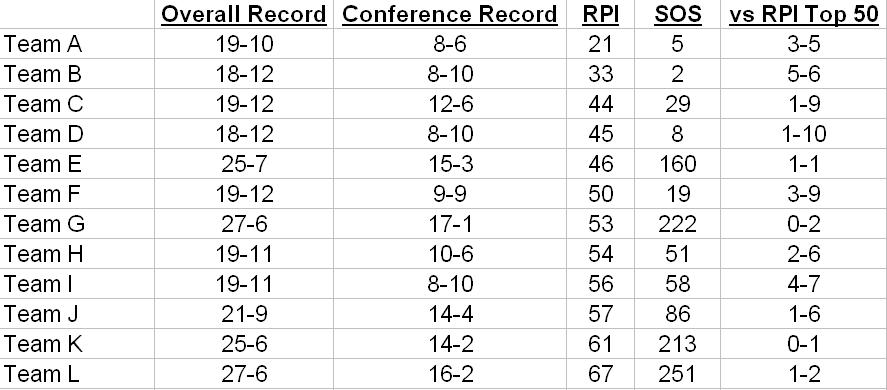
It's tough to tell when we get down to those last five or six teams in the field. All we can do is go by the numbers. As tired as this game may be, let's go to the blind resumes! Who do you like?


Eight of the twelve are in the field according to Joe Lunardi, and seven are in according to Jerry Palm. Which four or five would you leave out? Answers coming up in a bit.

What impresses you from the above? Do you like Teams A and B? They played impossible schedules, took some lumps but did manage to get a few quality wins.

Teams C and D also played tough schedules, but have repeatedly come up short against top-notch competition. Do they get rewarded for the tough schedules or punished for the lack of big wins?

Teams E, G, K and L  piled up a lot of wins against mediocre competition but combine for two wins against the RPI top 50. Do all of those wins give them a pass on their weak schedules, or should they be punished for never playing or beating anyone? The players can't control who they play. They can only beat the teams on their schedule, but other teams played and beat better teams.

Okay, answer time. Who did you have in and out?
A - Colorado State
B - Connecticut
C - South Florida
D - Northwestern
E - Iona
F - Texas
G - Oral Roberts
H - Xavier
I - Seton Hall
J - Washington
K - Middle Tennessee
L - Drexel

My opinion: teams with an RPI in the 30's or better with some quality wins like UConn and Colorado State need to be in. The dilemma for me is choosing between teams that never played or beat anyone great (Drexel, Middle Tennessee) and teams that had their shots at the top teams but lost almost every time (South Florida, Northwestern). I think some of the little guys like Iona should be in over the big schools that had their shots and failed over and over.

Obviously, some of these teams are going to be left out. Maybe it would be right to trim a few teams out of the huge conferences and let a few small teams in. It's a shame that teams like Oral Roberts and Drexel can have one bad loss ruin an otherwise great season while teams like Connecticut and Texas only need one good win to make up for a season of mediocrity.

Honestly, I think smaller leagues should do away with conference tournaments and give their bids to the regular season champion like the Ivy League does. The idea of having a conference tournament to allow other teams to steal a bid really only benefits the bigger conferences. It punishes the champions and devalues the regular season in smaller leagues.

All the little guys can do right now is hope the other bubble teams have bad first-round conference tournament losses, the kind of ugly losses that make the committee say, "Forget these guys. They've had their shot. Let's look elsewhere."

The committee has shown some more love to mid-major conferences lately. UAB and VCU surprisingly got in last year, and VCU made a historic run to the Final Four. Their run came just five years after fellow CAA team George Mason surprisingly got in and also made a Final Four run.

Letting small teams in can be fun, but let's not forget one big problem with limiting the number of bids to the big conferences: they have a lot of good teams, many of which would probably coast to a Summit League or MAAC championship. Do you remember who finished ninth in the Big East last season?


Tuesday, February 28, 2012

Potential Bid Thieves

Technically, there are 37 at-large bids for the NCAA tournament. We all know that number ends up being smaller as underdogs inevitably win a few conference tournaments to earn a bid and shrink the at-large pool.

Here are some  teams and tournaments that bubble teams should be worried about. To clarify, these are teams that have no chance at an at-large bid and are in leagues that have at least one team that is certain to be in the NCAA tournament.

La Salle, St. Bonaventure, UMass (Atlantic 10)
Probably no tournament will have more bubble teams on edge than the A-10. Temple and Saint Louis are the only real locks in the league. Saint Joseph's and Xavier are on the bubble, so they may or may not steal a bid by winning. There are probably three or four other teams that realistically have a shot at winning. I would be really concerned about La Salle, though. La Salle is 18-11 with an RPI of 89, which isn't awful but does put them outside of the at-large contenders. The Explorers have seven losses in the league, but all have been close. The tournament is in Atlantic City, meaning several La Salle students and fans will make the short trip from Philadelphia. St. Bonaventure and UMass could also make a run depending on the draw. Beware the A-10 tournament. It almost always steals a bid.

Cal State Fullerton, UC Santa Barbara (Big West)
A small league like the Big West makes people nervous. It has one team (Long Beach State) with strong NCAA credentials (19 wins, RPI of 36) and a bunch of teams with no business being in the field. Fullerton and Santa Barbara are the only teams that could capitalize on a Long Beach State slip up, as they are the only teams other than the 49ers that are above .500 in the league. Bubble teams everywhere are huge Long Beach State fans.

George Mason, Old Dominion (Colonial)
The Colonial is probably a one-bid league, maybe two as Drexel and VCU are at the top. A win by George Mason or Old Dominion in the finals over either of those two could take a bid away, however. The committee has shown respect to this league in the past. As we all remember, George Mason and VCU have surprisingly got in from this league in the past and made it all the way to the Final Four.

Tulsa, Central Florida, Marshall (Conference USA)
Jordan Clarkson and TU have been playing well lately,
and they could be a team to fear at the C-USA Tournament.
C-USA is a two-bid league with Memphis and Southern Miss. Memphis almost always wins the conference tournament when it hosts as it does this season. Bubble teams should be nervous about Tulsa, however. The Golden Hurricane has played really well lately and almost upset Southern Miss (the conference leader at the time) on its home floor. Tulsa still has a shot to claim the regular season title if it wins both of its last two (including Memphis at home) at Southern Miss drops one more. Central Florida (RPI of 60) and Marshall (59) have decent credentials and could also steal a bid, but Tulsa's recent strong play has my attention.

Loyola, MD (MAAC)
With 24 wins and an RPI of 42, Iona leads the MAAC and has a decent shot at an at-large. The Gaels have lost to Loyola once, however, and a loss to them in the MAAC Championship might cost a bubble team a bid. If Iona loses early in the tournament, however, Iona may not get into the field and a Loyola upset win might not steal a bid.

Northern Iowa, Illinois State, Evansville, Drake, Missouri State, Indiana State (Missouri Valley)
The Missouri Valley might have bubble teams more nervous than the Atlantic 10. Behind NCAA locks Creighton and Wichita State, there are five teams in the league at 9-9 and Indiana State right behind at 8-10. Bubble teams everywhere are pulling hard for a Jays/Shockers final, but anything could happen in this tournament.

Tennessee State, Morehead State, Tennessee Tech (Ohio Valley)
Murray State has been a bit of a hot topic this year considering how high the Racers have been ranked despite a modest schedule. All bubble teams, though, fear the Racers tripping up in their conference tournament. Tennessee State handed Murray State its lone loss on the season while Morehead State and Tennessee Tech both played very good games. Any of these three could knock off the Racers in Nashville.

Oregon, Colorado, UCLA, Stanford (Pac-12)
We've all taken our shots at how mediocre the Pac-12 is. No team in that league is a lock right now, but Washington and California look pretty good with Arizona not far behind. There is no doubt there is a lot of parity in this league. I would say just about any team has a shot at winning this thing because I have no confidence in anyone in it. Most likely, an underdog winning this tournament would just steal a bid from one of the other bubble teams in the league, but you never know. Bubble teams from other leagues, though, want Washington or Cal to take this one.

Tennessee (SEC)
I wouldn't bet a dime on it, but the Volunteers have some talent and could pull a shocker. They only lost to Kentucky by three at home (but they did lose by 25 in Lexington). If Kentucky gets caught napping, it's more likely that one of the league's tournament locks (Florida, Vanderbilt, Alabama) or bubble team Mississippi State claim the SEC tournament. Keep an eye on the Vols, though.

South Dakota State (Summit)
This one is borderline, but it's worth mentioning. The Summit League's regular season champ, Oral Roberts, isn't quite a tournament lock. Although, if ORU loses in the Summit League finals, the Golden Eagles would be 28-6 and currently have an RPI of 45. That would make them an interesting case for an at-large bid. Bubble teams would much rather ORU win the Summit League tournament and claim that bid than have someone else take it and have another bubble team in the pool. South Dakota State is the clear favorite to take the bid from ORU since the Jackrabbits handed ORU its only regular season conference loss, and the tournament is in Sioux Falls.

So, there you have it: ten potential bids that could be stolen. It's unlikely that all of these tournaments are claimed by underdogs. If you've ever watched Championship Week, though, you know at least a couple will.

Monday, February 27, 2012

A Tip to the Aspiring Journalist

I don't claim to be an expert on how to be a great journalist, but after nearly nine years in the business, I'd like to think I know a few things. If I could offer one piece of advice to the young folks out there who want to enter this field (whether TV or newspaper or other), it would be this: value being right over being first.

It's great if you can be both. Ultimately, being both right and first should be your goal. Those who can do both consistently are at the top of the industry. However, in today's fast-paced media world, there are some who would rather be first and apologize later if they turn out to be wrong. I can't really pick out a specific person who does this, but it does happen too often. Most of the people I've come across do their jobs the right way. There have been instances lately, however, when someone trying to throw something out there first has created quite a mess.

The worst example of this recently was when a Penn State blog was posted that Joe Paterno had passed away. Someone at CBSSports.com saw that and posted it on their site, and word spread through Twitter and the internet like wildfire. CBSSports.com ended up with egg on their faces when the family had to come out and say that Paterno was still alive and fighting for his life. Paterno died the next day, but that doesn't change the fact that some bad information added stress and anxiety to an already difficult time for Paterno's family. One extra phone call (from either the blog or CBSSports.com) to confirm Paterno's passing would have avoided that. Someone, though, had to be first.

Everyone involved issued apologies for getting the story wrong, but the damage was done to both the sites and to the Paterno family.

That's the big problem with the Twitter-era of journalism: all information travels fast, including bad information. Once you put a tweet out there, it's out there and you really can't take it back. You can try to delete it, but it just takes a couple people to see it and run with it. This past fall, a television station in Kansas tweeted erroneously that Mack Brown was retiring after the season. A few hundred retweets later, Mack Brown had to be asked about it and laugh at how ridiculous the report was.

The recent Ryan Braun situation was similar, but not exactly like the previous two. It's more about some irresponsible person leaking information that should not have been leaked. Again, the information spread quickly. Once someone heard from a source that the NL MVP tested positive for drugs, the race to be first with the news was on. Ryan Braun fell under the "cheater" label before all the facts were in. I can't blame any media outlet for running with the story, however. MLB suspending Ryan Braun for 50 games was a fact, and there was no harm in reporting it. The problem was more that all the facts were not in. Braun's name is now cleared (for the most part), but I'm sure several people will continue to look at him with skeptical eyes.

So, kids, if you're going to enter this field, go right ahead if you're passionate about it. Don't be afraid to chase and confirm controversial stories, because they can really build your reputation and put you on the fast track to success. Just make sure you are right before you run with a story and toss it out there on Twitter or blogs or wherever. Way too many out there fail to do so, and that needs to stop.

Friday, February 24, 2012

Buzz Williams at his Best

Marquette's win Friday night at West Virginia was a great night for Buzz Williams. It was a perfect microcosm of why Golden Eagle fans (and many others) love the guy, and it had almost nothing to do with what happened during the game. It was about what happened before and after.

There's a lot to love about Buzz Williams.
Before the game, Buzz suspended four players for half the game (Vander Blue, Junior Cadougan and Darius Johnson-Odom for the first half and Todd Mayo for the second). This isn't the first time this season Buzz has suspended players for all or part of game for unspecified team rules. Williams is big on discipline, and he said he needs to teach his guys life lessons.

When asked for specifics about what rules were broken, Williams never reveals those. He keeps those problems in house. As a fan, I want to know what's going on. It would be nice to know exactly what these guys are doing. Are they breaking curfew? Swearing? Cheating on tests? Not eating their vegetables? A little transparency would be nice. However, I can understand Williams wanting to keep these things private. I would imagine that it helps any hurt feelings over the suspension to heal a little more quickly if no one knows what's going on.

Williams simply says things like, "Do you have kids? Do you discipline them? Okay." And we all get it. I'm not sure I get suspending them for half of an important game when you could punish the players in practice, but I guess that's why Williams is a head coach making millions of dollars and I'm a producer/blogger making... well, less than that.

That was all before the game. It tells us that Williams is maturing as a coach. After the rumors of lack of control and alleged assaults that happened last season, it is good to see Williams is laying down the law and teaching his players lessons that they will need after basketball is done.

Then there was what happened after the game. Buzz dancing on the court showed his quirky personality that has made him such a media darling. We've seen crazy sideline antics, hilarious soundbites and great stories from him before. It's part of his charm. It's easy to praise him when he's your own coach. If I were a West Virginia fan, I'd be ticked. Thankfully, I'm not a West Virginia fan. I've never burned a couch in my life.

Williams likes to play himself off as a dumb Texas hick sometimes, but he's not nearly as dumb as he makes himself out to be. He's actually very smart. Maybe his little dance was simply a case of a guy getting caught up in the emotions of a big win. Then again, there may be a part of Williams that knew exactly what he was doing. Nobody outside of West Virginia likes West Virginia, and rubbing it in a little as they head to the Big 12 was just perfect.

No doubt. Buzz has some Al in him.
Doesn't it remind everyone of Al McGuire? There's the classic photo of Al McGuire waving to the Wisconsin student section after a big win. And I may be off here, but I've heard that the iconic photo of Al McGuire waving with two hands was actually Al waving sarcastically to some heckling Notre Dame fans. True or not, that's the Al that Marquette fans loved. It's why they love Buzz Williams, too.

I've written this entire blog about why Williams was at his best on Friday night, and I've yet to talk about how he coached during the game. He played half the game with only six guys, and he led the team back from 11 down at the half (and down by as many as 15) with another player suspended.

The guy is getting it done. I love having Buzz Williams as Marquette's coach, and I hope he stays there a long, long time.

A couple other quick nuggets from Friday's win:
- The Big East Player of the Year race is over. Jae Crowder won it. He didn't have his best night shooting the ball, but still got 26 points while Kevin Jones had just 12. He was the glue that kept that team together in the first half when those three guys were sitting out. It's time to talk about Crowder as an All-American. He might not make the first team, but who knows?
- Seeing Marquette play without Junior Cadougan for a half then getting him back made it crystal clear how critical he is to Marquette's transition game. They need him to play well, and he did.
- Marquette still misses Davante Gardner a little, but only a little. He won't get his starting job back if/when he is healthy. This team is playing too well. Gardner will become a valuable player off the bench as a big man, though.
- Earlier in the year, I (and many other #mubb Twitter folks) groaned over every slow Marquette start. They have overcome so many, however, I don't think I'll get bent out of shape even if they are down 30 at some point this season. They keep rallying to win these games, and that's a credit to Buzz Williams.

I have no idea how far this team can go in March, but there is really a lot to like right now.

Monday, February 20, 2012

The Myth of the "Full 40 Minutes"

I don't blog much about my favorite team, the Marquette Golden Eagles. This is probably because the market is pretty much covered on Marquette blogs: there are the hilarious super fans at Anonymous Eagle, the students who are close to the program at Paint Touches, and the in-depth statistics over at Cracked Sidewalks. Between those three and a few others, pretty much everything is covered.

As the season goes along, we are all running out of complaints about this team. Many of us (myself included) groaned over the slow starts, some bad shot selection and the concern about leadership when the team was struggling in December. Darius Johnson-Odom and Jae Crowder have certainly soothed some of those concerns lately. The team is getting better each time out. The leadership issue is definitely no longer a concern, as this team would be nowhere without its seniors. The team may not be perfect, but the flaws are becoming less noticeable. One question we see and hear a lot, though: can they put together a full 40 minutes? My response to that: how often does anyone ever really play a full 40 minutes?

While it would be nice to dominate a team from the opening tip to the final buzzer, that rarely happens in conference play and the NCAA tournament. Every team makes a run. Even if it's only a little 7-0 run to make you sweat a little, every team will make some sort of run.

Marquette may have played its best game of the season against UConn on Saturday, when the Golden Eagles won by 15 at the XL Center. MU was in control from the opening tip, but UConn was able to get within four points before a technical foul swung the momentum back to Marquette. Did MU play a "full 40?" No, but it's hard to complain about that effort overall.

I think playing a "full 40" is a myth like "giving 110 percent." It might not be possible, but it's a nice dream to shoot for so you never get content. I thought about this after the Oral Roberts win over Akron on Saturday. ORU senior Dominique Morrison was asked if the win could have gone any better. He laughed and said, "Yeah, we could have made more shots and they could have made less shots. It can always go better."

He's right. I don't know if ORU could say they played a "full 40," but they played pretty darn well and were very proud of the win.

In the end, having more points after 40 minutes is more important than playing a full 40 minutes. Even if a team does struggle for five minutes, it really doesn't matter if the team dominates the other 35. Sure, shoot for a full 40 next time because you never want to stop improving. We fans should just remember that if our only is complaint is "they didn't play a full 40," then things are going pretty well.

Sunday, February 12, 2012

I Can Survive Without Football... For Now

It's our first weekend without football since August. Most people are bummed. Some are complaining on Facebook and Twitter about what they are going to watch or do. Others are already starting the countdown to kickoff this fall.

Me? I'm good.

I don't hate football. I like it very much, but I'm okay with the break. I'd like to enjoy a few other things, give myself some time to miss football, and I'll be anxious for it to start again come August.

I need some time to appreciate college basketball. I need March Madness. I need my baseball. I need to work on my golf swing... a lot.

I need a break from Sunday morning preview shows. I need a break from Tebow Mania. I need a break from complaining about the BCS.

Maybe it's because I went to a college that didn't have football. Maybe it's because I work in sports television and football can be a grind, but I'm comfortable with a little football hiatus.

The offseason gives football players a chance to rest up and come back better than ever, much like a rainy day waters the flowers so those sunny, 80-degree days look even better. So, while the rain may not be what you want, know it's necessary sometimes.

I'll enjoy the football offseason because there are a lot of other sports I like to catch up on. When August gets here, though, I'll be anxious for football just like the rest of you. That's when the offseason rain stops and that beautiful, sunny football season will look as good as ever.